Shadow AI Coding Agents: The Security Risk Your Engineering Team Isn't Talking About
Your engineering organization probably has an approved list of AI coding tools. Your developers are using more than what is on that list.
The shift from shadow AI assistants (a data leakage risk) to shadow AI coding agents (a data leakage, unauthorized access, and infrastructure compromise vector) changes the calculus entirely. These tools are running in your development environment without your knowledge, with your developers' permissions, against your codebase.
What Shadow AI Coding Agents Look Like
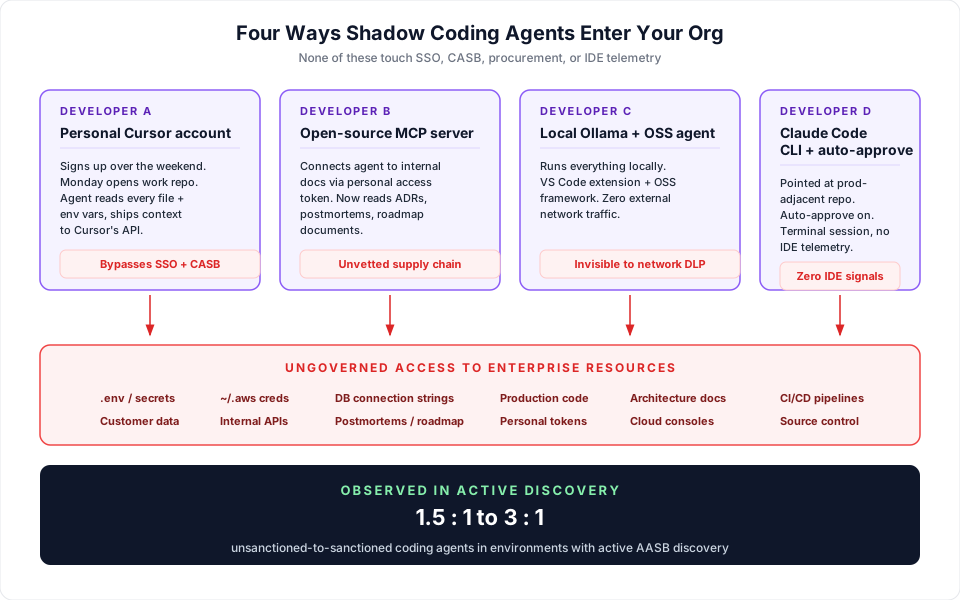
A developer signs up for a personal Cursor account over the weekend. Monday morning, they open their work repository. The agent reads every file, accesses environment variables, and sends context to Cursor's API. Nothing appears in SSO logs, CASB dashboards, or procurement systems.
Another developer installs an open-source MCP server connecting their agent to internal documentation. The server authenticates with a personal access token. The agent can now read architecture decision records, incident postmortems, and roadmap documents.
A third developer runs Ollama locally with a VS Code extension and an open-source agent framework. No external network traffic. Zero visibility from network-based detection.
A fourth developer pulls Claude Code, points it at a production-adjacent repo, and turns on auto-approve. The terminal session never shows up in the IDE telemetry your security team collects.
In organizations with active agent discovery, the unsanctioned-to-sanctioned ratio typically lands between 1.5:1 and 3:1.
Why Shadow Coding Agents Are Harder to Detect
Ambiguous network signatures. A connection to api.anthropic.com could be sanctioned or personal. Local models produce no external traffic at all.
No SSO authentication. Personal Cursor or Windsurf licenses authenticate with the vendor directly. Your identity provider never sees the event.
Invisible MCP connections. Local MCP servers communicate over standard HTTPS or stdio. No distinctive signature, no centralized registry.
Fast, decentralized adoption. New tools go from a Hacker News post to forty developer machines faster than you can schedule a security review.
CLI agents have no IDE telemetry. Claude Code and similar terminal-based agents do not show up in IDE plugin inventories.
The Risk
Uncontrolled data flows. Shadow coding agents have no guardrails: no content exclusions, no DLP, no data classification policies. Every accessible file is fair game, including .env files, ~/.aws credentials, and database connection strings.
Unvetted supply chain. Third-party MCP servers, IDE extensions, and plugins your security team has never evaluated. Developers making trust decisions on behalf of the organization. The Amazon Q Developer supply chain compromise in 2025 demonstrated what happens when a trusted developer-facing AI tool ships malicious behavior.
Audit gaps. Shadow agents cannot be logged. Your answer to "what AI tools access your production codebase?" is incomplete. In SOC 2, ISO 27001, NIST AI RMF, EU AI Act, FFIEC, or PCI DSS 4.0 contexts, that is a finding.
Catastrophic action risk. A shadow agent with auto-approve enabled can take production-impacting actions with no human in the loop. Replit's coding agent deleted a production database in 2025 operating within its granted permissions. A shadow agent has the same capability with none of the visibility.
Detection
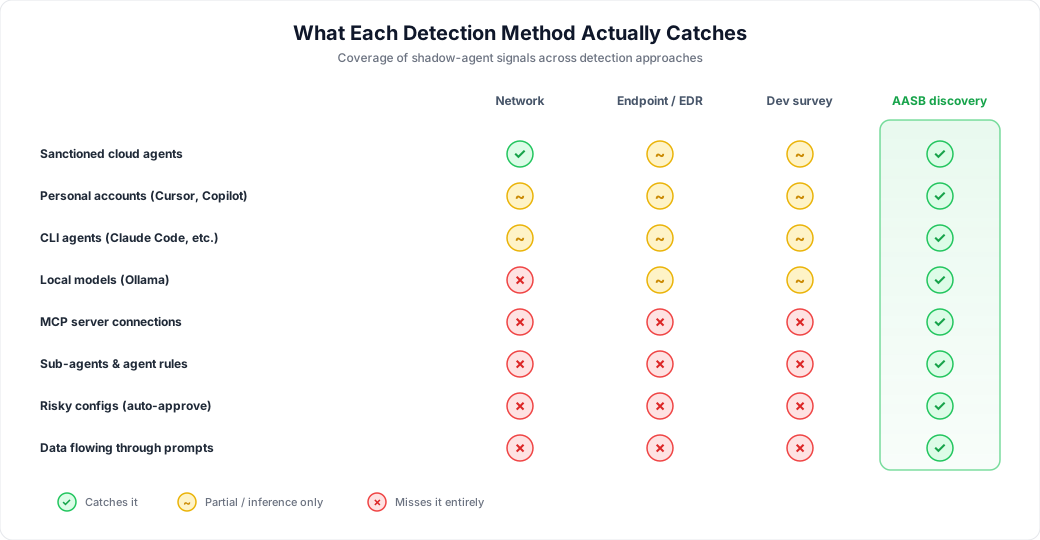
Network monitoring. Watch for connections to known AI API endpoints: api.anthropic.com, api.openai.com, copilot-proxy.githubusercontent.com, api.cursor.sh, api.codeium.com, and others. Alert on unassociated users.
Endpoint detection. Monitor for known coding agent processes. Cursor, Windsurf, Claude Code, and Ollama all have identifiable signatures.
Developer surveys. Anonymized surveys framed as "help us support your tools" surface what technical detection misses.
AASB discovery. An Agent Access Security Broker combines network, endpoint, and behavioral signals. It catches MCP connections, sub-agents, and agent rules other methods miss, and it works for CLI agents that have no IDE plugin presence.
Building Governance That Works
Detection without a workable governance path produces shelfware. The pattern that scales:
→ Fast approvals. Target a 48-hour initial review. If approval takes six weeks, developers will use the tool for five before approval comes through.
→ Expand the approved list. A short approved list with a long shadow list is worse than a longer approved list with consistent governance applied.
→ Communicate the why. "Coding agents can access and transmit credentials without your knowledge, and we need to monitor for that" is a reason. "Do not use unapproved tools" is just a rule. Developers respond to the first.
→ Detect alongside govern. When shadow agents are found, start with a conversation about needs, not a violation notice. Then onboard the tool through the AASB so it stops being shadow.
→ Enforce with tooling. An AASB that detects unsanctioned agents, alerts the security team, applies provisional policy, and blocks data transmission until review provides a safety net policy alone cannot.
Where to Start
Run a network scan for AI API endpoints. Cross-reference against your approved inventory. Send an anonymous survey. Request an Unbound risk assessment for AASB-level discovery. Those four data points tell you whether shadow coding agents are a minor gap or a major blind spot.
For the broader risk framework, see The CISO's Guide to AI Coding Agent Risk. For governance philosophy, see How to Govern AI Coding Agents Without Killing Productivity. For the AASB primer, see What is an AASB?. For the macro picture, see State of AI Coding Agent Risk.
Take Action
See it in your environment. Request a free risk assessment and discover what coding agents and MCP servers are running in your environment within hours.
Book a demo. See unsanctioned agent discovery, posture analysis, and policy enforcement in action at getunbound.ai/book-demo.

Co-Founder & CEO, Unbound AI
Raj is Co-Founder and CEO of Unbound AI (YC S24), building the AI Agent Security Broker (AASB) for enterprises adopting AI coding agents. Previously led DLP and CASB at Palo Alto Networks, and launched RASP and serverless security at Imperva. MIT Sloan alum. Pioneer Fund Venture Partner.
Connect on LinkedInAbout Unbound AI
Unbound AI is a YC-backed (S24) company building the AI Agent Security Broker (AASB), the governance layer enterprises use to safely deploy AI coding agents like Claude Code, Cursor, Copilot, and Codex. Unbound AI raised $4M in seed funding led by Race Capital in 2025, with participation from Y Combinator and other investors. Learn more
Ready to govern your AI coding agents?
Full visibility in under 5 minutes. No code changes. No developer workflow disruption.
Related articles
Unbound Brings Full Enforcement to GitHub Copilot

What is an Agent Access Security Broker (AASB)?
